
Learning jazz guitar begins with three foundational skills: understanding chord extensions (7ths, 9ths, 11ths, and 13ths), developing your ear to recognize ii-V-I progressions, and mastering the major scale across the entire fretboard. Most dedicated students spend 6 to 12 months building these fundamentals before confidently improvising over standard jazz tunes, though your timeline depends entirely on daily practice consistency and prior musical experience.
The beauty of jazz guitar lies in its accessibility. You don’t need expensive gear or formal music school credentials. A decent guitar, a metronome, and access to lead sheets get you started. What matters is systematic practice: learning vocabulary through transcription, internalizing the language of bebop and swing, and connecting with other musicians who push your growth.
Canada’s vibrant jazz community offers tremendous resources for learners at every stage. Local jam sessions in Toronto, Montreal, Vancouver, and smaller cities provide real-world testing grounds where theory meets performance. Many accomplished players share Canadian musician advice that emphasizes listening as the most critical skill, often more valuable than drilling scales alone.
This guide walks you through the complete learning path: what tools you actually need, how to structure effective practice sessions, the step-by-step progression from basic voicings to fluid improvisation, and how to verify your progress through performance milestones. Jazz guitar rewards patience and curiosity, and the journey itself becomes as satisfying as the destination.
What You’ll Need to Start Your Jazz Guitar Journey
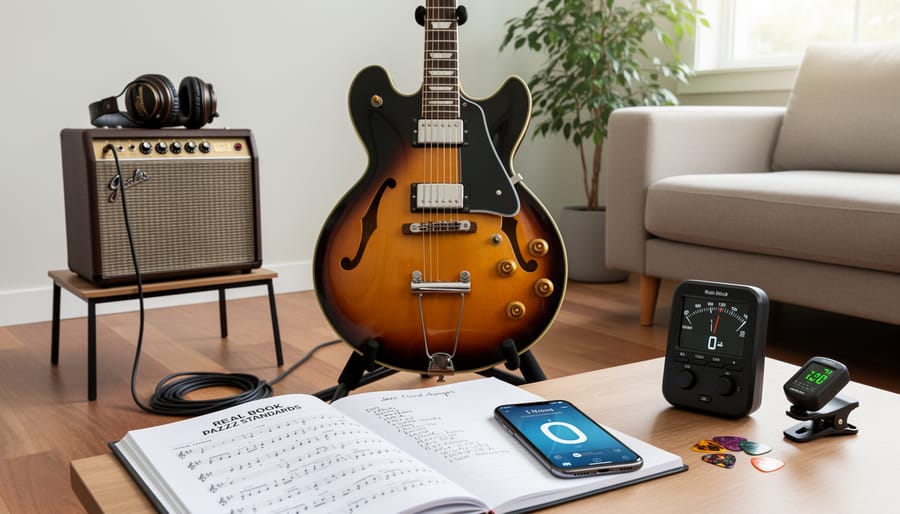
You don’t need expensive vintage gear to start your jazz guitar journey. While a hollow-body archtop is traditional, any electric guitar with decent tone will work, many Canadian jazz players began on solid-body instruments they already owned. What matters more than your guitar is building a solid practice foundation and connecting with the right resources.
Here’s what you actually need:
- A guitar (archtop, semi-hollow, or any electric with warm tone)
- A small amplifier with clean headroom
- A reliable metronome or drum app
- The Real Book or digital lead sheets
- A recording device (your phone works perfectly)
- Canadian jazz albums for reference listening
The guitar choice deserves clarification. Semi-hollow bodies like ES-335 style instruments offer versatility for both jazz and other genres. Full hollow archtops produce that classic warm jazz tone but can feedback at higher volumes. If you’re starting out, use what you have rather than delaying your practice to save for specific gear.
For amplifiers, think clean and simple. A 15-watt tube or solid-state amp gives you enough volume for home practice and small jams. Many players in Toronto and Montreal jazz scenes use modest Fender or Roland combos. Skip the heavy effects, jazz guitar tone comes from your touch and note choices, not pedals.
The metronome is non-negotiable. Jazz demands impeccable time, and practicing with a click builds the rhythmic foundation everything else rests on. Free apps work fine, though some players prefer physical metronomes for their visual beat indicator.
Lead sheets from the Real Book give you the chord changes and melodies for hundreds of standards. The legal sixth edition costs around forty dollars, or you can find individual charts online. Learning to read these simple melody-and-chord charts is part of the jazz language.
Recording yourself reveals what actually happens versus what you think happens during practice. Your phone’s voice memo app captures enough detail to hear timing issues, wrong notes, and tone problems. Review recordings weekly to track real progress.
Finally, start listening to Canadian jazz guitarists like Ed Bickert, Lorne Lofsky, and contemporary players shaping the scene today. Your ears need models to follow. Many Canadian music libraries offer free streaming access to jazz collections, and volunteer-run community radio stations across the country feature regular jazz programming that introduces you to both classic recordings and current local artists.
Before You Begin: Setting Realistic Expectations
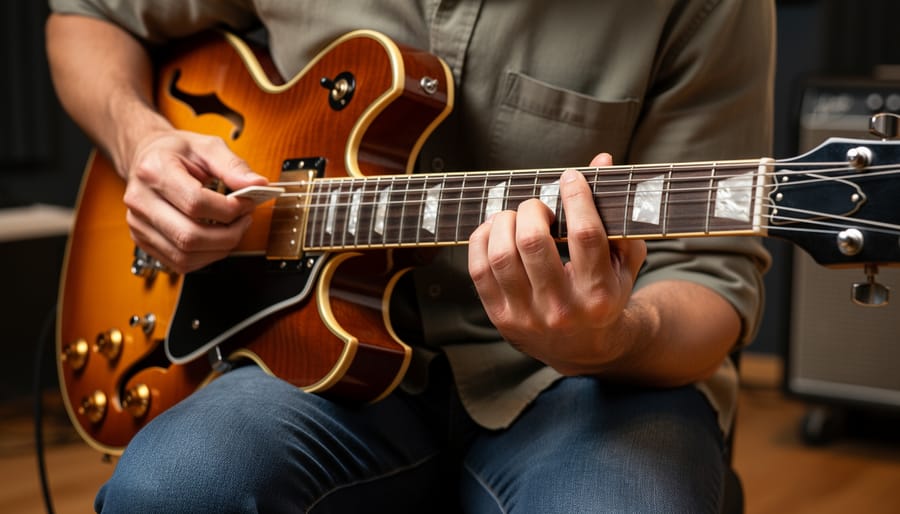
Learning jazz guitar demands patience, more than most players anticipate. The harmonic complexity and improvisational nature can feel overwhelming at first, and that’s completely normal. What separates successful jazz students from those who quit isn’t talent; it’s adopting the right learning mindset and avoiding the traps that derail beginners.
The biggest mistake new jazz guitarists make is rushing into advanced concepts before mastering fundamentals. You can’t improvise convincingly over “Autumn Leaves” if your seventh chords are shaky, and trying to transcribe Charlie Christian solos before you understand basic voice leading creates confusion, not progress. Build your foundation methodically.
Expect to sound awkward for months. Jazz phrasing feels unnatural at first, the syncopation, the chromatic passing tones, the way bebop lines resolve. Your fingers won’t obey your brain immediately. Recording yourself weekly reveals progress that daily practice obscures; you’ll hear improvements you can’t feel in the moment.
Another common pitfall is practicing in isolation too long. Jazz is a conversation, not a monologue. Connect with other players early, even if you feel unprepared. Vancouver, Toronto, Montreal, and cities across Canada have welcoming jazz communities with beginner-friendly jam sessions and open mics where making mistakes is expected and encouraged. Local music collectives and volunteer-run workshops offer judgment-free spaces to experiment. Finding mentors and peers who remember their own struggles makes the frustrating stretches bearable and reminds you that every jazz guitarist started exactly where you are now.
Your Step-by-Step Jazz Guitar Learning Path
Step 1: Build Your Jazz Chord Vocabulary
Start with four essential chord families that form the foundation of jazz harmony: major seventh (maj7), minor seventh (min7), dominant seventh (dom7), and diminished seventh (dim7). Focus on learning just two or three voicings for each type initially, prioritizing shapes on the middle four strings (D, G, B, E) since these sit perfectly in the band mix and move easily up the neck.
Practice these chords in one key first, C major works well, then shift each shape up and down the fretboard. A Cmaj7 shape at the 5th fret becomes Dmaj7 at the 7th fret, Ebmaj7 at the 8th fret, and so on. This moveable approach means learning four shapes gives you all twelve keys instantly.
Voice leading matters more than knowing hundreds of voicings. When moving from Cmaj7 to Dm7, find the version of Dm7 where most notes stay close to your previous chord, ideally moving by just a fret or two. This creates smooth, professional-sounding progressions and trains your ear to hear chord relationships.
Spend fifteen minutes daily on chord drills. Play through common progressions like ii-V-I (Dm7-G7-Cmaj7) using your new shapes, focusing on minimal finger movement between changes.
Step 2: Start with Jazz Blues
The 12-bar jazz blues serves as your ideal training ground because it combines simplicity with genuine jazz harmony. Unlike basic blues, the jazz version incorporates ii-V-I movements and chord substitutions that appear throughout the standard repertoire.
Start by learning the progression in F: F7 | Bb7 | F7 | Cm7-F7 | Bb7 | Bdim7 | F7 | Am7-D7 | Gm7 | C7 | F7-D7 | Gm7-C7. Play through it with quarter-note strumming until the changes feel automatic. This progression gives you a manageable twelve measures to internalize voice leading and harmonic movement.
Practice comping first. Work on smooth transitions between chords, then add rhythmic variation with Charleston rhythm or other swing patterns. Once you’re comfortable accompanying yourself, improvise simple melodies using the F blues scale, gradually incorporating chord tones and approach notes.
Many Canadian jazz sessions open with a blues, so this progression connects you directly to the community. The repetitive structure lets you focus on phrasing and dynamics rather than memorizing complex changes.
Step 3: Learn Your First Jazz Standards
With chord vocabulary and blues under your belt, you’re ready to tackle jazz standards, the songs that form the backbone of the jazz repertoire. Start with melodically strong tunes that appear at jam sessions regularly: “Autumn Leaves,” “Blue Bossa,” and “All the Things You Are” are excellent first choices because they use common chord progressions and move through keys predictably.
Learn the melody first, without chords. Sing it, then play it on one string to internalize the phrasing and rhythm. Jazz melodies carry specific articulations and swing feel that you’ll miss if you rush straight to harmony. Once the tune is in your fingers, map out the chord changes and practice comping while humming the melody.
Seek out Canadian interpretations to hear how local players approach these classics. Lorne Lofsky’s lyrical reading of standards and Ed Bickert’s chord-melody arrangements demonstrate distinctly thoughtful approaches. Many Canadian jazz festivals archive performance videos that showcase regional styles, these recordings reveal how standards transform through individual voices while maintaining their essential character.
Step 4: Develop Chord-Melody Skills
Chord-melody playing transforms you into a complete one-person band, weaving melody and accompaniment together simultaneously. Start with simple tunes you know well, think “Happy Birthday” or basic jazz standards. Play the melody on the higher strings while adding bass notes and essential chord tones underneath.
Begin by harmonizing just the melody notes. If the tune lands on a chord tone, voice that chord beneath it. Don’t overthink the bass movement initially; focus on smooth voice leading where chord tones move by small intervals rather than large leaps.
Practice each phrase slowly, identifying which fingers handle melody versus harmony. You’ll often use your pinky and ring finger for melody while your index and middle fingers grab chord tones below. This feels awkward at first but becomes intuitive with repetition.
Once comfortable with basic arrangements, explore drop-2 voicings, these spread chord tones across the fretboard beautifully, placing melody naturally on top.
Step 5: Explore Jazz Scales and Improvisation
Once you’re comfortable with chord melodies, it’s time to develop your improvisational voice. Start with the major scale modes, Dorian for minor chords, Mixolydian for dominant 7ths, and Ionian for major 7ths. Practice each mode over a single chord vamp until the sound becomes familiar.
Bebop scales add chromatic passing tones that let your lines land on chord tones at strong beats. The dominant bebop scale (adding a natural 7th between the flat 7 and root) is especially useful for ii-V-I progressions. Play these scales ascending and descending at various tempos with a metronome.
Begin crafting phrases by targeting chord tones on downbeats, then connecting them with scale passages. Record yourself soloing over a backing track for just eight bars of a standard you know. Listen back critically, are you outlining the harmony or just running scales? The goal isn’t technical perfection but musical conversation. Your lines should respond to what the chords are saying.
Step 6: Transcribe and Learn from the Masters
Transcribing solos note-by-note from recordings is how jazz musicians have always learned the language. Pick a short solo or even just a single phrase that catches your ear. Slow it down using software like Amazing Slow Downer or your phone’s playback controls, then figure out each note on your guitar. Write it down or record yourself playing it back.
Start with melodic players whose phrasing is clear: Wes Montgomery’s thumb tone makes notes easy to hear, and Grant Green’s blues-based lines are approachable. For Canadian voices, listen to Lorne Lofsky’s lyrical solos or Ed Bickert’s chord-melody work. Both exemplify how to build coherent statements over changes.
The goal isn’t just copying notes. Once you’ve learned a phrase, transpose it to all twelve keys, then try inserting it into your own solos over similar chord progressions. You’ll gradually internalize the rhythmic feel, note choices, and musical logic that define jazz guitar vocabulary. Transcribing even one chorus per month builds your musical vocabulary faster than any book.
Step 7: Join the Jazz Community
Getting better at jazz guitar means playing with other people. Canada has an active jazz community waiting to welcome new players, and you’ll learn faster in a few jam sessions than in months of solo practice.
Start by searching for “jazz jam session [your city]” to find weekly events. Most cities host beginner-friendly jams where the house band supports newcomers through standard tunes. Arrive early, introduce yourself to the organizer, and mention you’re still learning, they’ll guide you to appropriate moments to sit in.
Check community centres, music schools, and jazz cafés for open mic nights. Universities often run student jazz combos that accept community members. Join local Facebook groups like “Toronto Jazz Musicians” or “Vancouver Jazz Scene” to find players at your level for informal practice sessions.
Recording yourself at these events helps you hear what needs work. The immediate feedback from playing alongside experienced musicians will transform your understanding of time, comping, and musical conversation faster than any method book.

How to Know You’re Making Progress
Tracking your progress in jazz guitar isn’t about achieving perfection. It’s about recognizing when you can do things today that felt impossible six months ago. The clearest sign you’re moving forward is playing through an entire jazz standard without stopping, even if it’s slow and imperfect. When you can navigate chord changes in real time and make musical choices rather than just surviving the progression, you’ve crossed an important threshold.
Recording yourself reveals progress you might miss during practice. Listen back to recordings from three months ago and compare them to today. You’ll notice improvements in time feel, chord voicing clarity, and the smoothness of your melodic lines. Many Canadian jazz guitarists recommend recording your practice sessions weekly, even if it’s just on your phone. The recordings don’t lie about what’s working and what needs attention.
Playing with other musicians provides the most honest feedback. If you can hold down a chord progression while someone else solos, respond to what a bass player is doing, and trade phrases with other instrumentalists, your jazz vocabulary is functioning. Jam sessions will feel less overwhelming as you develop. You’ll recognize more tunes by ear, anticipate chord changes, and feel comfortable jumping in rather than sitting out most of the session.
Set specific benchmarks for yourself. Can you play three jazz standards from memory? Do you know chord shapes across the entire fretboard? Can you improvise using arpeggios over ii-V-I changes? Can you comp through a blues progression in different keys? These concrete goals give you something measurable to work toward.
Next steps depend on where your interests lie. Some players dive deeper into chord-melody arrangements, others focus on bebop vocabulary and fast lines, and some explore modern jazz styles or Brazilian jazz. Connect with teachers and experienced players in your local scene for guidance on what to tackle next.
Canadian Jazz Guitar Resources and Community
Canada’s jazz community offers exceptional resources for guitarists at every stage of their journey. From coast to coast, you’ll find dedicated teachers, thriving festivals, and welcoming organizations that make jazz education accessible and engaging.
Major cities host established jazz guitar instructors who teach both privately and through music schools. Toronto’s Royal Conservatory, Montreal’s McGill University, and Vancouver’s Capilano University all offer jazz programs with guitar faculty. Many instructors also teach through community music schools at more affordable rates, with some offering sliding-scale fees or group classes to increase accessibility.
Jazz festivals across Canada create invaluable learning opportunities beyond formal instruction. The Montreal International Jazz Festival, TD Vancouver International Jazz Festival, and Toronto Jazz Festival feature workshops, masterclasses, and educational programming alongside performances. These events let you hear world-class guitarists live and often include clinics where you can learn directly from touring artists. Attending festivals also exposes you to diverse styles and connects you with fellow jazz enthusiasts in your region.
Volunteer-run organizations form the backbone of Canada’s jazz education landscape. Local jazz societies in cities like Victoria, Calgary, Edmonton, and Halifax organize jam sessions, concert series, and educational events run by passionate community members. These grassroots initiatives create inclusive spaces where beginners can learn alongside experienced players without financial barriers. Many feature mentorship programs pairing emerging guitarists with established local musicians.
Online communities like Canadian Jazz Collective and provincial music educators’ associations provide additional support, connecting you with resources and other learners nationwide. This collaborative spirit reflects Canada’s broader commitment to supporting Canadian artists and fostering inclusive musical communities where everyone can participate and grow.
Common Questions About Learning Jazz Guitar
Do I need to read music to play jazz guitar?
No, many successful jazz guitarists learn primarily by ear, using chord charts and tablature. However, reading standard notation opens up more learning resources and makes communication with other musicians easier.
How long does it take to learn jazz guitar?
You can play simple jazz tunes within 3-6 months of focused practice, but jazz guitar is a lifelong journey. Most players develop a comfortable vocabulary for jam sessions after 1-2 years of consistent work.
Can I learn jazz guitar without a teacher?
Yes, with quality online resources and self-discipline, but a teacher accelerates your progress significantly. They catch bad habits early and provide personalized feedback that books and videos can’t offer.
Is jazz guitar harder than other styles?
Jazz requires understanding harmony and improvisation more deeply than most styles, but it’s not inherently harder. The challenge lies in the theoretical knowledge and listening skills rather than physical technique.
Don’t let these common concerns hold you back. Every jazz guitarist you admire started exactly where you are now, wrestling with the same questions. The Canadian jazz community is particularly welcoming to beginners, with many volunteer-run workshops and mentorship programs designed specifically for players taking their first steps into the genre. Your background in other guitar styles transfers more than you might think, those hours spent learning rock solos or folk fingerpicking have already built finger strength and musical intuition that applies directly to jazz. The real question isn’t whether you can learn jazz guitar, but when you’ll start.
Learning jazz guitar is a deeply rewarding journey that’s completely within your reach, no matter where you are in Canada or what level you’re starting from. You don’t need to be a virtuoso to begin, just a willingness to explore, practice consistently, and connect with the vibrant community around you.
What makes this journey special is how much support you’ll find along the way. From volunteer-run jam sessions in community centres to festivals showcasing incredible Canadian talent, the jazz community thrives on collaboration and shared learning. Every chord you master, every standard you learn, and every improvisation you attempt adds to your musical vocabulary and connects you to a rich tradition that’s alive and thriving across the country.
Remember, jazz guitar isn’t about perfection, it’s about expression, creativity, and growth. Take advantage of the resources available to you, support local jazz artists by attending shows and sessions, and don’t hesitate to reach out to fellow musicians. The path ahead will challenge you, but it’ll also bring moments of pure musical joy that make every practice session worthwhile. Your jazz guitar journey starts now.